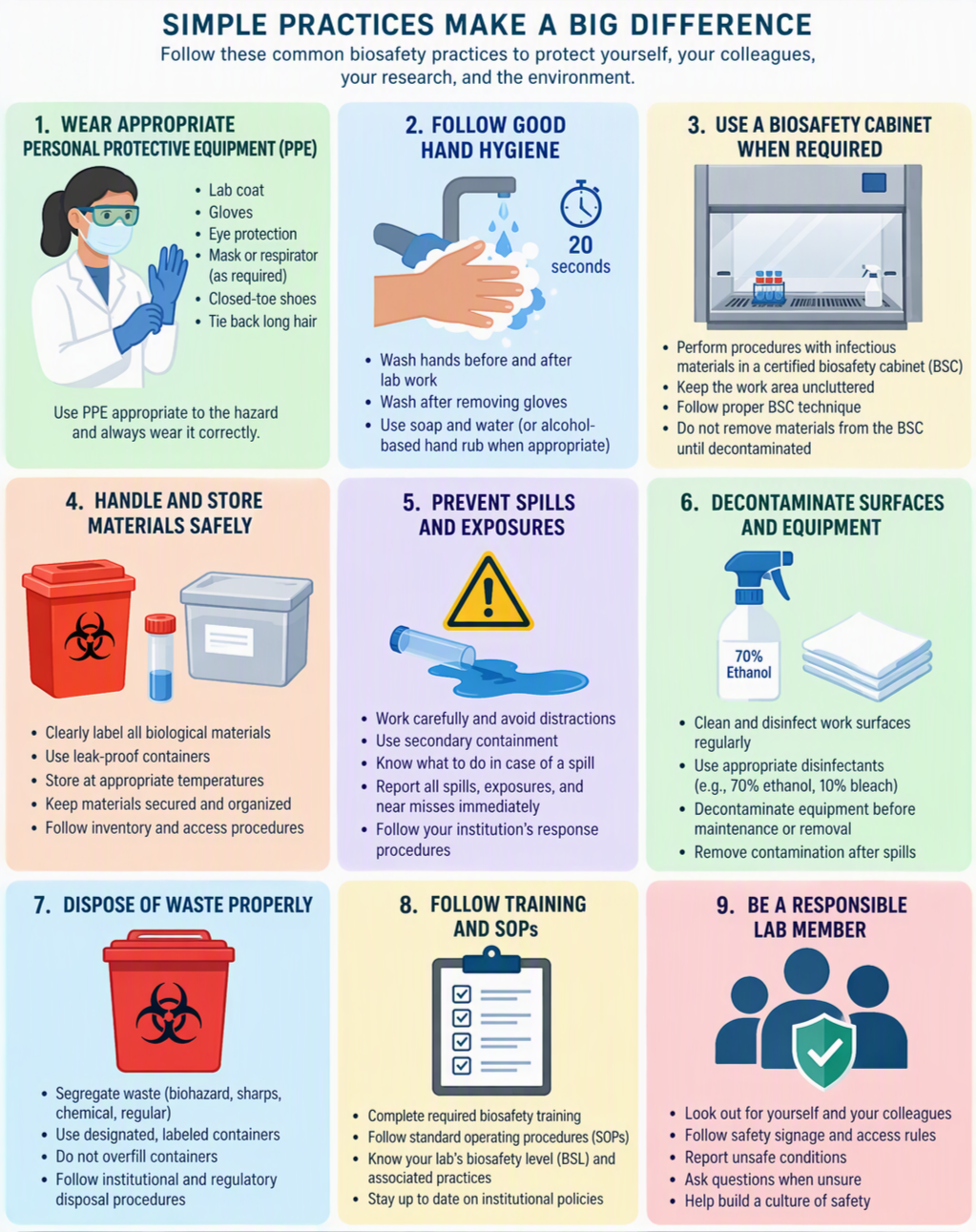
Biosafety
Biosafety is defined as the containment principles, technologies and practices that are implemented to prevent unintentional exposure to biological agents or their inadvertent release. The development, implementation and oversight of biosafety at the organizational level is the Biosafety Program. A Biosafety Program uses a variety of information that includes institutional policies, guidance documents, procedures, planning documents (training, recruitment, emergency/incident response) and record keeping (personnel, inventories, incident management). A set of minimum requirements for a Biosafety Program are defined in the fourth edition of the World Health Organization (WHO) Laboratory biosafety manual. This manual outlines a number of risk control measures that are both the foundation and an integral part of laboratory biosafety. These measures reflect best practice in biosafety that are necessary to work safely with biological agents, even where the associated risks are minimal. Good laboratory biosafety practice is essential for keeping workers, the community and the environment safe from unintentional exposure or release of pathogenic biological agents.
October was biosafety month, so make sure your organisation is following best practice to keep everyone safe! Contact Biorisk Busters for information on customised biosafety training for your team.
Links to free downloadable resources
CDC Biosafety in Microbiological and Biomedical Laboratories (BMBL) 6th Edition
McClusky et. al. (2025) Laboratory biosafety risk assessment: A critical component of avian influenza preparedness. Journal of Biosafety and Biosecurity, 7(1). https://doi.org/10.1016/j.jobb.2025.02.001 (this article provides a downloadable risk assessment template as supplementary material)